
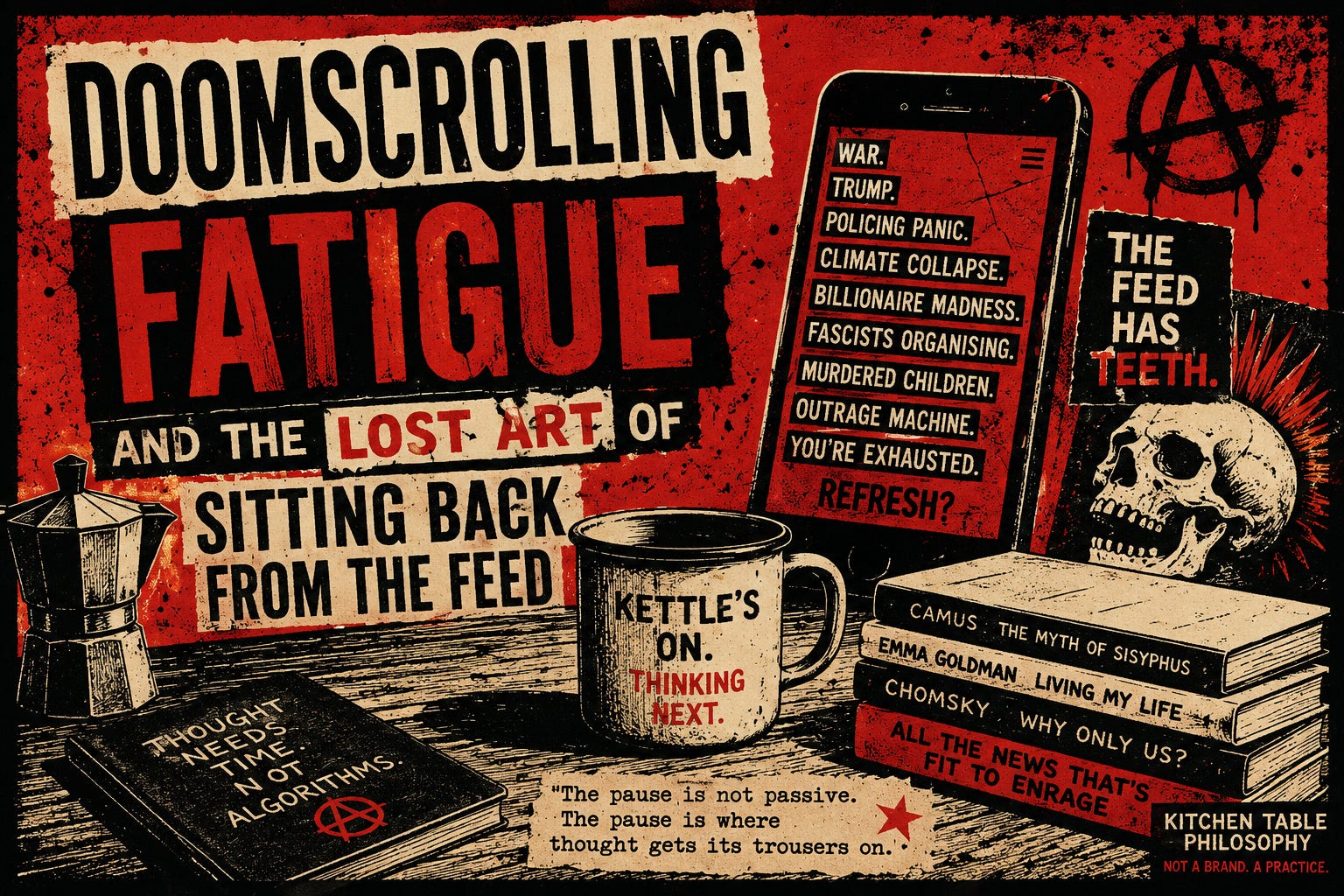
I opened the news feed and immediately regretted having a nervous system.
There it was, waiting for me like a looming black dog with bad intentions: war, Trump, policing panic, coal being dressed up as “new” energy progress, military chiefs talking like we’re three headlines away from eating beans in a bunker, and whatever fresh national psychosis BBC Question Time had coughed into the carpet overnight.
This, apparently, is staying informed. You don’t read the news anymore. You get mugged by it.
You open your phone and the algorithm kicks your front door in wearing a hi-vis jacket with BREAKING written across the back. It doesn’t inform you. It raids you. It barges in before breakfast, throws geopolitical shit up the walls, sets fire to the curtains, then asks if you’d like to turn on notifications.
And the really grim bit is this: I don’t even need to open the feed anymore to feel it.
That’s the thing I keep coming back to. This isn’t just doom-scrolling. Doom-scrolling was when we couldn’t stop looking. Doom-scrolling fatigue is different. Doom-scrolling fatigue is when you are tired before you even start. It is the little bodily flinch before the app opens. The dread before the headline loads. The sense that your phone is no longer a window onto the world, but a haunted letterbox where every morning someone drops a flaming bag of propagandised poop on your doorstep, and runs away.
And because we are modern, sensible, emotionally well-adjusted people, we call this “engagement.” Because nothing says healthy democratic participation quite like absorbing war, fascism, climate collapse, murdered children, billionaire madness, institutional failure, celebrity idiocy, culture-war slurry, and an advert for over-priced easy meal-prep boxes before you’ve even had a cup of tea.
The human mind is a miraculous thing. It can love, imagine, remember, grieve, laugh, build, dream, write poetry, make soup, invent jazz, paint gods on cave walls, and convince itself that one more biscuit doesn’t count if the packet was already open.
But it was not built to emotionally process the entire planet before breakfast. That is not a moral failing. That is biology quietly asking what the hell we think we are doing. The feed has teeth. That’s how it feels now.
Not like a place. Not like a tool. Not like a newspaper, or a conversation, or even the old internet, back when it was mostly weird forums, terrible fonts, badly compressed gifs, and someone called DragonLord1978 explaining how to fix a dot matrix printer.
The feed feels predatory. It waits. It promises connection and delivers cortisol. It is not a window onto the world. A window suggests you can look out, take in the view, maybe close the curtains if next door are arguing in the garden again. The feed is not a window. The feed is a one-armed bandit that mugs you, rather than paying out.
Pull to refresh. War. Pull again. Trump. Pull again. A dead teenager turned into a slogan by people with the emotional depth of a pub toilet. Pull again. Someone selling you a miracle new protein supplement. Pull again. A politician saying “hardworking families” with the hollow confidence of a man who has never met one without calling security. Pull again. A dog in sunglasses. Pull again. Recycled AI arguments. Pull again. A celebrity being cancelled. Pull again. Someone screaming about how they hate “others” not like them, while having a quote in their bio about Jesus loving everyone.
And there you are, thumb moving, eyes drying out, soul quietly leaving the room through a side door. This is what we are doing to ourselves. Every day. Sometimes before we’ve even had a morning piss.
And I know the usual answer is to say, “Well, just log off then.”
Brilliant. Thank you, Professor Obvious. I had not considered simply removing myself from the entire infrastructure through which modern information, work, art, friendship, politics, community, and public life are now filtered. Very helpful. Shall I also go and live in a tree and communicate by trained crow?
The point is not that we can simply leave. Most of us can’t. Not completely. Not honestly. Not without cutting ourselves off from parts of the world we do actually care about.
The point is that we need to understand what the feed is doing to us. And more importantly, what it is taking from us. Because the feed does not just take time. That’s the obvious theft. It takes attention. It takes nuance. It takes context. It takes the quiet space between seeing something and forming a thought about it.
And that space matters. That space is where judgement lives. The pause between headline and reaction is where the human being is supposed to happen.
And the feed is eating that pause alive.
Every part of it is designed to collapse the gap. Headline, reaction. Image, reaction. Outrage, reaction. Quote-post, reaction. Pile-on, reaction. Little red notification, little red alert in your nervous system. It wants you quick. It wants you raw. It wants you twitching. It wants you emotionally available to whatever fresh madness it has dragged in by the neck, and wants to drop in-front of you. It’s a rabid dog still trying to please its human.
The algorithm does not care whether you understand its intentions. It cares that you react. Preferably fast. Preferably loudly. Preferably before your better self has even woken up properly. The feed does not want citizens. It wants raw nerves with thumbs.
And this is where the whole thing starts becoming more than a rant about phones and feeds. This is where it becomes philosophical. Because I was hoping to just call the internet a haunted dumpster fire started by the ghost in the machine, feel pleased with my prophetic perfunctory prose and move on with my day, but no, here we are, dragging meaning out of the smouldering wreckage.
The deeper problem is not that the world is terrible. The world has always been terrible. It has also always been beautiful, absurd, tender, stupid, cruel, ridiculous, hilarious, and occasionally improved by a bacon butty, despite my high cholesterol count.
The deeper problem is scale. We are being asked to witness the whole world at once, all the time, without ritual, without distance, without digestion, without pause.
A war crime and a celebrity scandal arrive at the same size. A child’s death and a culture war meme sit next to each other like they belong in the same emotional filing cabinet. Fascism beside a banana bread recipe. Genocide under a sponsored post for trainers. Climate collapse, then someone’s breakfast food porn post. A humanitarian disaster, then a dancing cat. Government cruelty, then an advert for a sofa you accidently clicked on at once in March and will now be haunted by until death.
The feed doesn’t organise reality. It liquefies it. It turns the world into content soup, hands you a spoon, and expects you to feed yourself. But being exposed to everything is not the same as understanding anything. That may be one of the great lies of the age. We have mistaken exposure for knowledge. We have mistaken outrage for politics. We have mistaken reaction for conscience. We have mistaken constant contact with horror for moral seriousness. And the machine loves that.
The machine loves nothing more than a morally exhausted person who thinks feeling awful is the same thing as doing something. Because feeling awful keeps you scrolling. Feeling awful keeps you engaged. Feeling awful makes you share the post, watch the clip, read the thread, reply to the idiot, argue with the bot, check the update, refresh the feed, come back for more.
It turns your conscience into a battery, to be drained of all its energy. There is something obscene about that. Not just annoying. Not just unhealthy. Obscene. Human suffering is poured into the machine and comes out as engagement metrics. Everything becomes content.
And because everything becomes content, everything becomes strangely unreal. Not unreal because it did not happen. Unreal because it has been flattened, packaged, circulated, reacted to, monetised, memeified, and stacked between adverts until the human mind can no longer hold it properly.
This is where Baudrillard (yes I invoke him all the time) starts rattling around the kitchen like a ghost in a black polo neck. The real does not vanish. It becomes endlessly reproduced. It becomes image. The image becomes content. The content becomes engagement. The engagement becomes profit. And somewhere in that process, your morning becomes a casualty. You are acceptable collateral damage.
You opened the app to see what was happening. What happened was that reality came in wearing clown shoes and hit you with an over-sized mallet. And then comes the guilt. You knew it’d happen, you knew what the pay-off was going to be. As its always the same. Because, of course, the world really is full of horror.
This is the bit that stops the whole thing becoming some smug little “put your phone down” lifestyle sermon. People really are suffering. Wars really are happening. Fascists really are organising. Governments really are lying. Billionaires really are building private escape routes from the consequences of their own ideology.
The planet really does appear to be coughing up blood from the regular beatings it gets, while someone in a suit explains why this is excellent news for shareholders.
So when you step back, even briefly, the guilt starts sniffing around the door. Am I looking away? Am I being complacent? Am I trying to bury my head in the sand? Am I becoming one of those people who says “I don’t really follow politics” with the relaxed confidence of someone whose rights have never been treated as an optional subscription?
That is the trap. The machine offers us two settings. Hysterical engagement or dead-eyed apathy. Either you stay plugged in and let the feed turn your nervous system into soup, or you are apparently abandoning the world to the bastards.
But that is a false choice. A nasty little binary. And like most binaries, it deserves to be taken outside and quietly dismantled with a soup spoon.
There is another option. Look properly. Not constantly. Properly. There is a difference between witnessing and being shredded. There is a difference between staying informed and allowing an algorithm to use your conscience as the chew toy of salivating dog. There is a difference between care and panic. Care can think. Panic can only twitch. And twitching is very useful to the machine. Twitching translates as little bursts of moral performance flung into the void like confetti at a funeral.
But care needs space. Care needs breath. Care needs context. Care needs enough silence to become more than a reflex. This is where Kitchen Table Philosophy comes in. And I know, on the surface, Kitchen Table Philosophy sounds like a joke. One I keep harping on about.
It is a joke. Of course it is. Of sorts.
Everything serious should start as a joke, otherwise you end up sounding like a TED Talk with a beard. Kitchen Table Philosophy began, for me, as a way of bringing big thoughts down to ordinary size.
No academic gatekeeping. No dead men being used as intellectual furniture. Not some bloke in a university bar saying “dialectic” as if it might get him laid. Just the table. The kettle. The thought. The ordinary, messy, lived space where actual people try to make sense of the world without first applying for permission from the Philosophy Department.
But behind the joke there is something serious. Something I think is becoming more important all the time. The kitchen table is a place of human scale. It is where the world can be brought back down to a size we can think with. Just making things thinkable again.
Because that is what the feed takes away. Thinkability. It gives you everything, everywhere, instantly, endlessly, urgently. Kitchen Table Philosophy is the attempt to interrupt that. To sit back. To let the first wave of dread pass through before you mistake it for an opinion. To ask what actually happened. To ask who benefits from your outrage. To ask what is being hidden behind the noise. To ask whether your reaction is yours, or whether the algorithm has shoved its little hand up your back and started working your mouth like a sock puppet.
That is philosophy. Not as decoration. Not as performance. Not as a degree certificate in a frame. Philosophy as the pause. Philosophy as the breath before the reply. Philosophy as the stubborn refusal to be processed by the machine at the speed the machine demands.
And yes, that sounds dramatic. Good. It is dramatic. I love dramatic language.
We are living in a time where attention is harvested, anger is farmed, and despair is packaged as a push notification. If you can’t be dramatic about that, what can you be dramatic about? The price of cheese? Actually, yes, also the price of cheese. That is obscene too. But one apocalypse at a time.
The point is this: sitting back is not passive. The pause is not weakness. Thinking slowly is not surrender. In a world that wants you constantly triggered, constantly available, constantly reacting, constantly feeding the machine little pieces of yourself, sitting back becomes a form of resistance.
Not the glamorous kind. No barricades. No flags. No dramatic soundtrack. Just a person at a table saying: wait! What? No! No, you are not going to do what is expected of you. It’s exhausting. And exhausted people are easier to manipulate. Frightened people are easier to herd. People kept in a permanent state of twitchy dread are much more likely to become cruel, cynical, tribal, obedient, numb, or just too bloody tired to resist anything at all.
The outrage machine does not need you thoughtful. It needs you available. Available for the next panic. The next pile-on. The next slogan. The next enemy. The next little dopamine pellet of righteous indignation.
And if it can keep you exhausted enough, it can make your politics smaller. Meaner. Less human. It can make you mistake spite for clarity. It can make you confuse being informed with being inflamed. It can convince you that the only moral position is to be permanently on fire. But people on fire are not usually known for their long-term strategic thinking. They are mostly known for being on fire.
So perhaps, before we become yet another little burning man running through the digital village screaming at strangers, we might need to reclaim something older. The pause. The table. The act of sitting back, and saying fuck that. Not to disengage. Not to float above the horror like some smug Zen monk with Wi-Fi. Not to say, “Oh well, nothing can be done,” and disappear into a cushion.
But to become useful again. To become human again. Because if we cannot think, we cannot care properly. If we cannot care properly, we cannot act properly. And if we cannot act properly, then all our outrage is just noise.
This is the metaphorical part I keep returning to. The kettle is not denial. The kitchen table is not retreat. Sitting back is not giving up. It is where the work begins. It is where panic becomes thought. Where reaction becomes judgement. Where outrage either earns its place or gets sent back to the digital dumpster it crawled out of.
It is where we remember that we are not machines for processing dread. We are not content farms with high blood pressure. We are not morally obliged to let every headline burst through the door and start shouting over breakfast.
We are human beings. Messy, limited, absurd, fragile, contradictory human beings. We need time. We need context. We need laughter. We need each other. We need the space to say, “Hang on, what is actually happening here?” That little sentence may be one of the most radical things left.
Hang on. What is actually happening here? Not what am I supposed to feel? Not which side is shouting loudest? Not how do I perform the correct reaction quickly enough to avoid being eaten by my own tribe? What is actually happening here?
That is where thought begins. Because without thought, we become exactly what the feed wants us to be: reactive, exhausted, predictable little creatures, twitching at the glass while civilisation sells advertising space on the way down.
The sitting back is the refusal to let the feed climb inside your chest and redecorate the place in panic. That is the lost art. And we need it back. Because doom-scrolling fatigue is not just tiredness. It is the exhaustion of being constantly summoned by crisis. It is the weariness of waking up already braced. It is the dread of opening the feed because some part of you knows the feed has teeth.
And if you are not careful, it will chew the morning out of you. It will leave behind sarcasm without warmth, anger without direction, and a vague desire to throw your phone into the wall. Which, to be fair, remains a perfectly respectable position.
But before we get to performance art phone destruction, perhaps we try something smaller. Kettle on. Sit down. Breathe. Look properly. Think slowly. Laugh where you can, because the bastards should never get the last joke. Then decide what deserves your attention. That is how we remain human in a system that would quite like us to become permanently outraged little thumb-creatures.
So yes, the world is on fire. Yes, the headlines are awful. Yes, the algorithm has once again arrived at breakfast dressed as a horseman of the apocalypse. Fine. Let it wait outside for five minutes.
I’m finishing this third pot of coffee before I face the feed again.

Kitchen Table Philosophy Archive is an ongoing series exploring politics, culture, philosophy, and the strange psychological landscape of the internet age.

Loved this post! It’s deeply refreshing to see someone else advocating for a tactical kitchen table pause in the digital matrix. I try to be pretty selective about my daily dose of algorithmic induced panic. Look, I stay informed because I have zero desire to become a silent monk, and I genuinely want to know what the hell is going on out there—ideally without sending my blood pressure into orbit. I always make sure to carve out time to actually think and reflect. It sounds a bit pompous saying it out loud, but hey, it beats letting a Silicon Valley server farm do my thinking for me.
Another piece worth reading.