
Before his visit the the United States, I did send King Charles III an Official Britsplainer to the USA badge before he left. I didn’t see it on his lapel…
But after that speech, I realised something quite important.
He didn’t forget it. He just… didn’t need it.
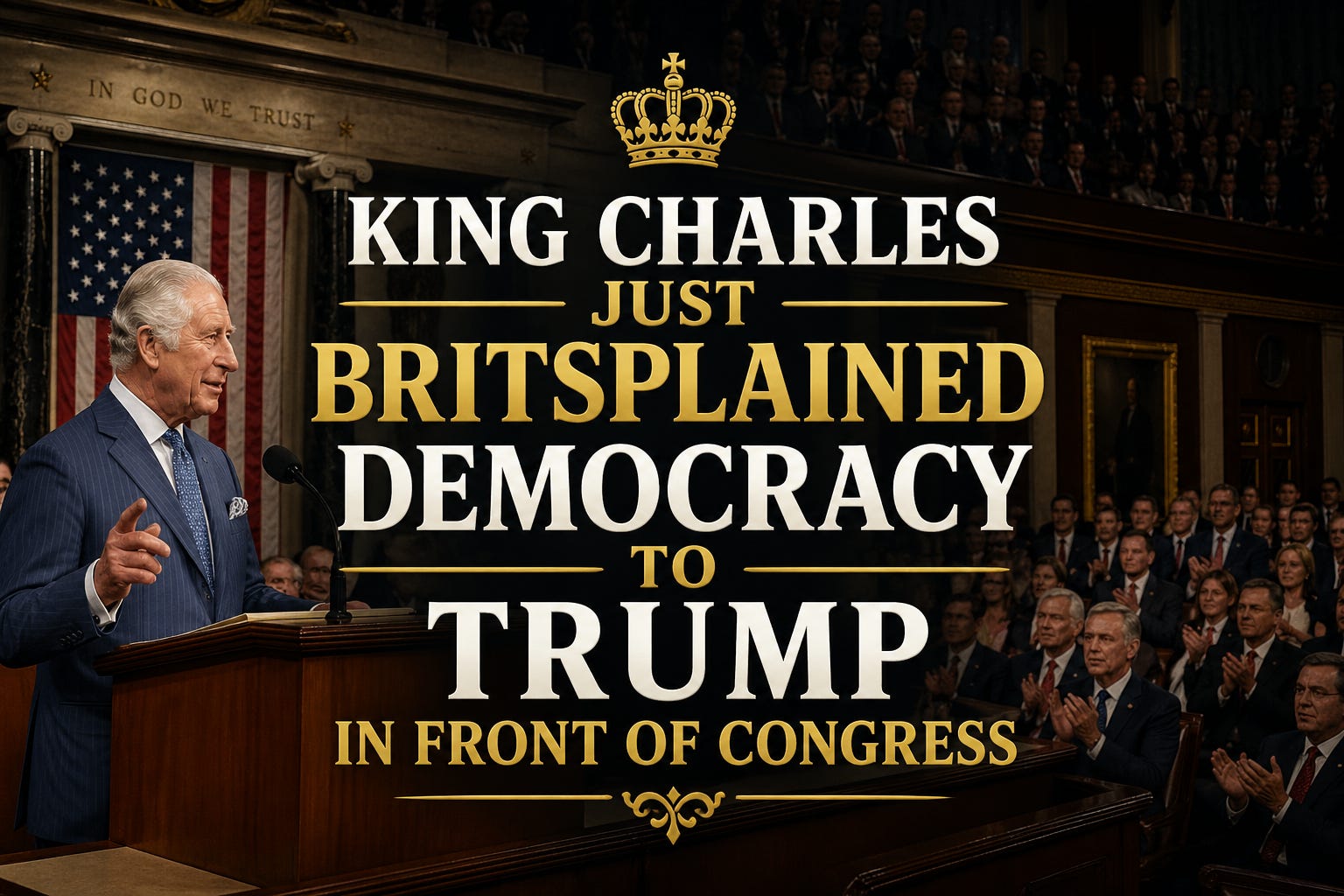
Because what he delivered to Congress wasn’t a speech. It was Britsplaining elevated to a constitutional art form. A slow, precise, immaculately mannered dismantling of the idea that power belongs to one man simply because he shouts the loudest and sells the most hats.
And the room knew it.
You could feel it in the reactions. The standing ovations didn’t come at random. They came at very specific moments, moments where, if you speak fluent British, you could hear the subtext ringing like a church bell.
The King Explains Why America Doesn’t Have One
Let’s start where the room erupted.
“Magna Carta… [is] the foundation of the principle that executive power is subject to checks and balances.”
That line landed hard. Reports have noted it drew one of the biggest responses in the chamber. I’ve watched the video, it was something to behold. Because that was a not history lesson. That was an instruction.
From a literal King standing in the United States Congress explaining, gently, politely, devastatingly, that the entire Anglo-American political tradition exists to stop leaders behaving like kings. That the very foundation of their laws, all the way up to the Supreme Court are woven from our history, and more importantly, how we the Brits deal with kings that abuse their power.
There is something almost offensively British about that. No raised voice. No accusation. No “Donald, pack it in.”
Just Magna Carta.
Which, translated properly, means: we’ve already tried unchecked rulers, we dealt with it.
“Not by the Will of One”
Then came the line that should be printed on the inside of every executive order folder:
“Not by the will of one, but by the deliberation of many.”
That is not decorative language. That is the whole argument. And more importantly, it is the whole rebuttal.
Because you don’t need to mention Donald Trump if you describe a system that fundamentally excludes his governing instinct.
The will of one is the dream. The deliberation of many is the design.
And Charles, in that moment, didn’t attack Trump. He simply described democracy in a way that made Trump sound… incompatible with it.
That’s sublime Britsplaining.
A Love Letter to Congress… and a Warning
Charles kept returning to Congress itself. Not the presidency. Not executive strength. Not decisive leadership.
Congress.
He called it a “citadel of democracy.” A place of “debate and deliberation.” A chamber representing the full voice of the American people. That’s not flattery. That’s positioning. Because if Congress is the heart of democracy, then anything that tries to bypass, dominate, or intimidate it is, by definition, the problem.
And again, here’s the delicious irony.
A hereditary monarch flew across the Atlantic to remind an elected republic how not to behave like the court of a king.
You couldn’t write it better.
The Climate Line That Wasn’t Really About Weather
Charles has been banging on about the environment longer than most politicians have been alive, so when he said:
“We ignore at our peril the fact that these natural systems… provide the foundation for our prosperity and our national security.”
He wasn’t just talking about trees. He was reframing climate entirely. Not as ideology. Not as culture war bait. But as security. Stability. Survival.
Which, if you’ve been watching American politics for the last decade, landed exactly as intended. It wasn’t subtle at all.
Coverage noted that his emphasis on climate, the judiciary, diversity, and alliances stood in clear contrast to the current administration’s instincts. That’s not accidental. That’s a carefully choreography take-down.
Ukraine, NATO, and the End of “America First” as a Strategy
Then we get to the geopolitical spine of the speech, the bit where the tone doesn’t change, but the meaning sharpens.
Charles doesn’t start with Ukraine. He starts with a shared memory.
“In the immediate aftermath of 9/11, when NATO invoked Article 5 for the first time… we answered the call together.”
That’s not a history lesson. That’s a reset point.
That is him reminding Congress of the one moment where the alliance functioned exactly as designed, America attacked, the rest of the world didn’t hesitate, didn’t negotiate, didn’t ask for terms. They just stood up. We, the UK stood up.
Then, calmly, he moves it forward:
“That same, unyielding resolve is needed… for the defence of Ukraine.”
And there it is. No grandstanding. No sermon. No accusation.
Just two moments, 9/11 and Ukraine, placed side by side and left hanging in the air like an unanswered question.
We stepped up with you then. Will you step up with us now?
And just in case anyone thought this was all a bit sentimental, he tightens it further:
“Our Alliance cannot rest on past achievements.”
That’s the line that kills “America First” without ever naming it.
Because that entire worldview depends on the idea that alliances are optional, conditional, transactional, something you dip in and out of depending on mood, optics, or polling.
Charles quietly dismantles that. Alliances aren’t nostalgia. They’re obligation. Continuity. Responsibility. You don’t get to dine out on 9/11 forever and then hesitate when it’s someone else’s turn.
He doesn’t say any of that directly. He just places the standard back on the table and lets the room measure itself against it.
That was diplomacy, but with a spine. A very British backbone.
“Ignore the Clarion Calls to Become Inward-Looking”
This is where the knife goes in properly.
“…that we ignore the clarion calls to become ever more inward-looking.”
Now, nobody needed a translator for that. That is isolationism. That is nationalism. That is the entire emotional engine behind modern Trumpism.
And Charles didn’t attack it. He simply described it as something to resist. That’s the trick. That’s the craft. That’s the whole British thing. That’s full on Britsplaining.
You don’t say “this is dangerous nonsense.”
You say, “we must be careful not to drift in that direction.”
And let everyone else do the thinking. Let that sit a while.
Diversity, Reframed as Strength (Again, Calmly Ruinous)
At one point, Charles described America as:
“the living mosaic of the United States.”
And followed it by saying that diverse, vibrant, free societies are the source of collective strength.
Now, if your political worldview depends on fear of difference, suspicion of migration, and the idea that cultural purity equals stability… that line hits like a brick wrapped in velvet. He wiped the floor with the whole MAGA movement in one go.
No outrage. No accusation. Just a calm assertion that diversity is strength.
And suddenly the entire opposing argument looks… a bit small. It looks weak, scared, backwards looking, and quite simply embarrassing.
Faith Without the Weaponisation
This is where Charles stops being merely polite and becomes quietly, devastatingly precise. He doesn’t avoid faith. He leans into it.
“For many here – and for myself – the Christian faith is a firm anchor and daily inspiration…”
So far, entirely familiar territory in American political language.
And then, very deliberately, he widens it:
“…to value all people, of all faiths, and of none.”
That line does an enormous amount of work.
Because what Charles is presenting there isn’t just Christian faith. It’s a constitutional version of it. A version that coexists. That restrains itself. That understands its place within a plural society rather than trying to dominate it.
And that stands in direct contrast to what’s currently emerging in parts of American politics: a project that doesn’t just express faith, but seeks to institutionalise it as authority. To fuse religion with state power. To turn belief into policy, exclusion into doctrine, and dissent into moral failure.
Charles doesn’t attack that outright. He does something far more British, and far more effective.
He models the alternative.
A Christianity that speaks of compassion, not control. Of understanding, not enforcement. Of light over darkness, not power over others. And then, almost as if to underline the point without raising his voice, he adds:
“…that, in these turbulent times… we can stem the beating of ploughshares into swords…”
That’s not just biblical language. That’s a rejection of the entire political instinct to weaponise faith in service of conflict, identity, and division. It’s a reminder that Christianity, in its own text, is not meant to be a tool of domination. It’s meant to be a restraint on it.
Which leaves an awkward, unspoken question hanging in the room:
If your version of Christianity requires control, exclusion, and power… what exactly are you practicing?
He doesn’t answer it. He doesn’t need to.
That’s Britsplaining at its most uncomfortable, calmly holding up a mirror and letting the reflection do the damage.
The Rule of Law, Explained Like It’s Obvious
Then came the bit that felt almost painfully polite.
“The Rule of Law… an independent judiciary… impartial justice.”
Just listing them. Like these are normal, agreed, non-negotiable foundations.
Which, of course, they are. Unless you’ve spent years attacking courts, undermining judges, and treating legal accountability as a personal inconvenience.
Charles didn’t say any of that. He didn’t need to. He just described how a functioning system works.
And let the contrast do the damage.
The Lincoln Line: The Final, Polite Mic Drop
And then, right at the end:
“The world may little note what we say, but will never forget what we do.”
That’s Abraham Lincoln, via the Gettysburg Address. And it’s not a flourish.
It’s the entire point of the speech.
America’s words carry weight, Charles said. But its actions matter more. That’s the quiet warning underneath everything that came before it.
Not the speeches. Not the slogans. Not the chants. What you actually do.
That is what history keeps.
The Badge Was There All Along
So no, he didn’t wear the badge I sent him. But it was there in spirit.
In every Magna Carta reference. In every mention of checks and balances. In every careful defence of NATO, Ukraine, climate reality, diversity, and the rule of law.
In every line that gently, politely, devastatingly said:
“You do realise your entire system was built to stop this, don’t you?”
That’s Britsplaining at its absolute peak.
Not loud. Not crude. Not angry. Just calm, precise, historically backed clarity delivered with a faint smile and centuries of receipts.
We should absolutely make it a national pastime.
At least until the lesson sticks. And Trump is gone. So crack on my fellow Brits, wear you Official Britsplainer to the USA badges with pride. Wear them literally, or as Charles did, wear them metaphorically.
Either way… Go forth and Britsplain, your country and the world needs you.
Read my piece on how all this Britsplaining to the USA thing started from my kitchen table… The Art of Britsplaining to the USA: A working description of a role we didn’t apply for and have absolutely accepted. All my Threads Britsplaining posts are archived here, on the Official Britsplainer Project webpage.
And a direct link to the shop of my website www.nothingisreal.world to get your own Official Britsplainer to the USA badge.

Brilliantly written
Do you think anyone who needed to receive this message, actually understood one single thing the King said?