Against Colour-Coded Bookshelves

I’ve noticed this for years.
In magazines.
On television.
In the soft-focus background of interviews where someone is supposed to be clever.
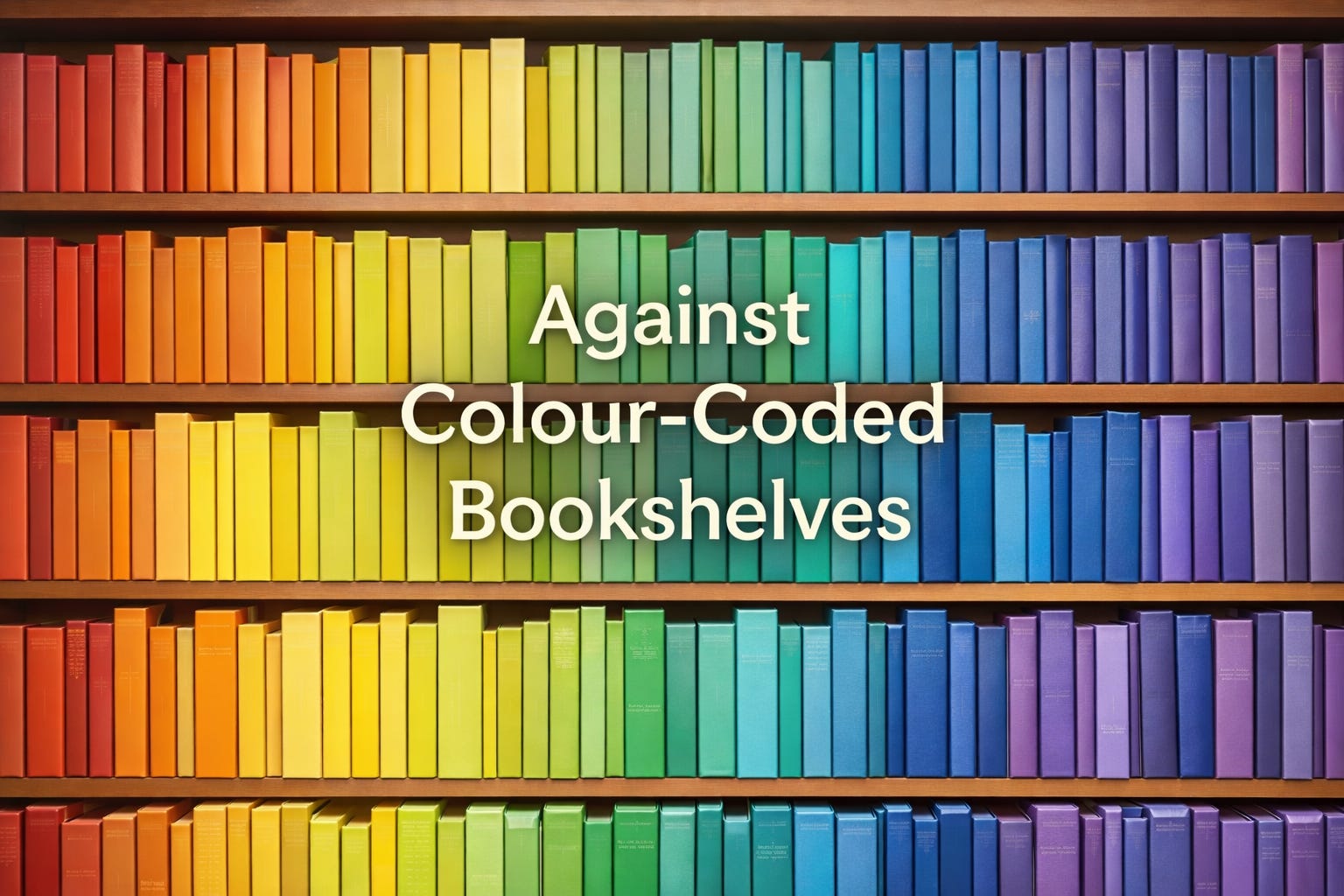
Bookshelves. Bookshelves where the books are fucking colour-coded.
Red into orange into yellow into green, like some sort of fucking literacy Pride parade, except there’s nothing proud about it. It’s not a library, it’s a showroom. It’s not knowledge, it’s décor. It’s not reading, it’s retail.
Because let’s be honest, if your books are arranged by colour, you don’t use them.
You pose with them.
Books aren’t cushions. They’re not plants. They’re not there to “bring warmth to the room”. They’re not a background texture to prove you’re the sort of person who might, at some point, have flirted with thinking.
Books are information. Memory. Argument. Obsession. Time compressed into paper. They’re meant to be pulled out, slammed shut, shoved back in the wrong place because you’ll need them again. They’re meant to wear. To crease. To gather scars.
Colour-coding kills that dead.
Because the moment you do it, you’ve admitted something:
you don’t care where the book is.
you don’t care what it says.
you care how it looks from the sofa.
Libraries don’t do this.
Readers don’t do this.
You organise books by author. By era. By subject. By the strange, stubborn, slightly irrational internal logic of your own brain. The logic that only makes sense to you and therefore makes perfect sense. Philosophy next to sci-fi because it belongs there, because they’re asking the same questions in different accents. Marx rubbing shoulders with cyberpunk. Kant quietly judging space operas. That’s not chaos, that’s correspondence.
Poetry shoved in wherever it fits because poetry never asks permission. It arrives sideways. It inserts itself between things. It refuses to stay put. You don’t shelve poetry so much as accommodate it. It turns up uninvited, makes itself at home, and leaves when it’s done with you.
Books sit together because they argue with each other. Because they contradict. Because one annoyed you and the other helped you work out why. Because you read one against another. Because you needed to keep them close so the fight stayed alive. Other books sit together because they love each other. Because one led you to the next. Because you couldn’t have read this without first reading that. Because they’re part of the same long, messy, unfinished conversation that you’ve decided, foolishly, gloriously, to join.
A real bookshelf is a map of how someone thinks.
What they return to.
What they resist.
What they haven’t resolved.
It’s not tidy.
It’s not symmetrical.
It doesn’t photograph well.
And that’s the point.
That’s how shelves work.
Colour-coding is what happens when books stop being books and start being bricks. Decorative bricks. Neutral-toned, well-behaved, silent bricks that promise intelligence without ever demanding engagement.
It’s performative literacy.
Shelf-based signalling.
Hardback cosplay.
And the thing is, I don’t even think it’s malicious. That’s what makes it worse. It’s not vandalism, it’s neglect. Books reduced to silence not by fire, but by fashion. No banning. No burning. Just tidying them out of relevance.
Because once books are arranged by colour, they stop talking to each other.
And once they stop talking to each other, they stop talking to you.
All that knowledge. All that argument. All that accumulated thinking.
Muted. Neutered. Neatly shelved.
A library turned into a mood board.
Which is fine, I suppose, if what you wanted was a room that looks clever without ever making you uncomfortable.
But that’s not a bookshelf.
That’s a confession.
They don’t read.
Or, more precisely: they don’t need books to speak, argue, interrupt, or change them.
A colour-coded bookshelf is a confession that books have stopped being tools and started being props. That knowledge has been neutralised into décor. That disagreement has been declawed into design. That the shelf exists to be seen, not used.
It confesses comfort over confrontation.
Aesthetic over argument.
Curation over curiosity.
It says: I want the appearance of a mind without the inconvenience of one.
That’s the confession.
So don’t judge a book by its cover, but judge the cunt that colour codes their fucking book covers.
If you enjoyed this colourful rant, you may enjoy this one…
Fading into Beige: The Disappearance of Colour and the Death of Vibrancy

I hope my Sibiu bookcases pass the sniff test. 🙂
A read rant with some blue words. Whether your pages are yellow or white, the ink black or brown, the covers puffin green or penguin orange you need to keep the spines straight or they’ll get cocked.
Looking forward to the album cover storage sequel.